Custom software or standard system?
Many businesses reach a point where they face the same question: Should we buy a ready-made system, or should we have software developed to fit our workflows?
There is no single right answer. But there are a number of signs that show when a standard system is enough and when it is a better investment to have a solution developed to fit your business. Here we go through them and show how we have solved it for other businesses.
Should you choose custom software or a standard system?
The short answer is:
- A standard system works well when your workflows are similar to most others'.
- Custom software is usually the better choice when your process is part of your business, or when manual work, double entry and errors cost you more than they should.
What suits you best therefore depends on how you work today. If a standard system covers your needs, there is rarely a reason to develop anything yourself. If you spend time on Excel sheets, detours between systems and manual checks, it may be a better investment to get a solution that fits your workflows.
Not sure what is right for you? Contact us for a no-obligation conversation about the options. We are happy to hear how you work today and will honestly tell you what we would recommend, even if the answer is a standard system.
Kontakt os
When is a standard system enough?
Standard software and SaaS solutions are a good choice if your needs are common. There are many good standard systems for e.g. accounting, CRM, inventory and project management. For many businesses, they are both the fastest and the most sensible solution.
This applies in particular if the budget for custom development is limited. A standard system can be put to use quickly, the vendor updates it continuously, and many employees already know it. If the system fits your workflows reasonably well, there is typically no reason to build anything yourself.
A standard system is usually enough when:
- You can work according to the system's standard processes without major detours.
- The system covers your most important needs, and the rest can be handled with settings.
- The task is not what sets you apart from others in your industry.
- You can keep the number of customizations down.
When systems don't talk to each other
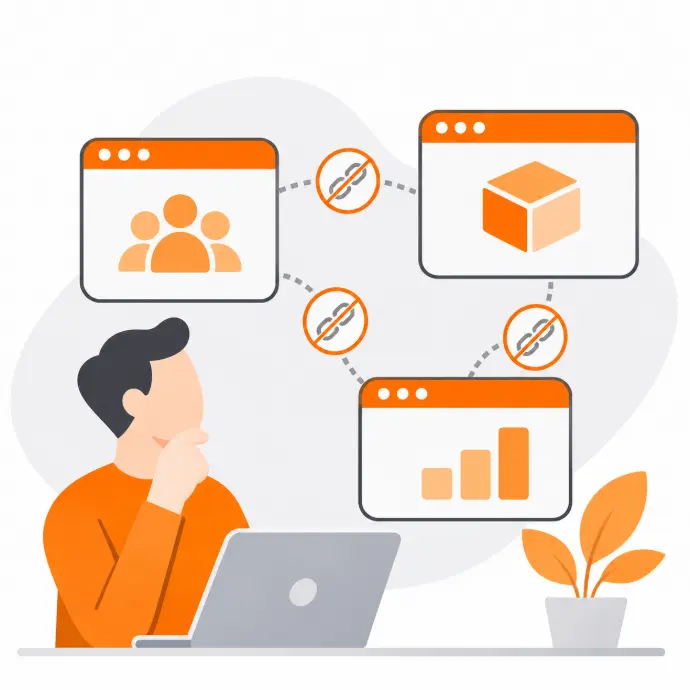
If you use several standard systems, the challenge often lies not in the systems themselves but in the fact that they are not connected. Employees then move data manually or enter it twice, which can cost both time and errors.
In that case, it is not always necessary to replace a system or develop an entirely new solution. With integrations between your systems, data can flow automatically instead. This means less manual work and fewer errors, and you can keep the systems you already know and trust.
Only when a standard system requires many customizations, or when the process is part of what makes you who you are, is it relevant to look at custom software. We look at that below.
Benefits of custom software
When a solution is built for your business, it is not the number of features that makes the difference, but that it fits your needs and work processes. Here are some of the benefits we see most often in practice:
In a standard system, your processes often end up adapting to the system. With custom software, we start from your workflows: Who does what, which data is needed, and where does it take unnecessary time today? The result is a solution that follows the way you actually work. Because it is built for exactly the tasks the users perform, it can also be made easy to adopt.
Many businesses find that a standard system often leaves Excel sheets and manual checks alongside it. With custom software, you can bring the whole task together. For example, we have previously helped JUAL A/S replace an extensive and complex Excel sheet for technical calculations with a configurator that performs the calculations and compiles the result in a professional PDF report. This saves time and reduces errors in calculations that would otherwise have to be made and checked by hand.
A custom-developed software solution can be built to talk directly to the systems you already use. This could, for example, be through system integrations with synchronization and sharing of data, or by making it possible to export a CSV file that can be imported into other IT systems. That way, you avoid entering the same information several times across systems.
When tasks and data are gathered in one system, you get an overview that scattered files and systems cannot give. This makes it easier to consult colleagues and share knowledge across the organization. In a custom software solution, you decide which roles and permissions should exist, and thereby who gets access to all or parts of the data.
When data is gathered in one place, it also becomes easier to follow up and make decisions. Data from the solution can also be used for reporting and analysis via data warehouse and BI.
Custom software can also be aimed at people outside your business. It could, for example, be a self-service solution for generating quotes, collecting documentation, submitting reports, etc. Here you can let customers create users and assign roles within their own organizations, so they decide who may create and approve quotes. This gives customers a faster process and relieves your team.
When the system produces reports and documentation itself, they get the same structure and the same information every time. This means less manual work and a more professional impression on customers.
A custom solution does not have to be finished when it goes live. With custom software, you can add new features, configurators, integrations, etc. as the need arises.
We have worked with this for several of our customers: JUAL A/S, for example, had a system developed with one configurator, to which more configurators can be added later. Nordic Waterproofing's solution started out as Tagpas and has since been developed further for several industries. Today it is called Sitepas.
In other words, you decide what is implemented next in your solution.

When can custom-developed software pay off?
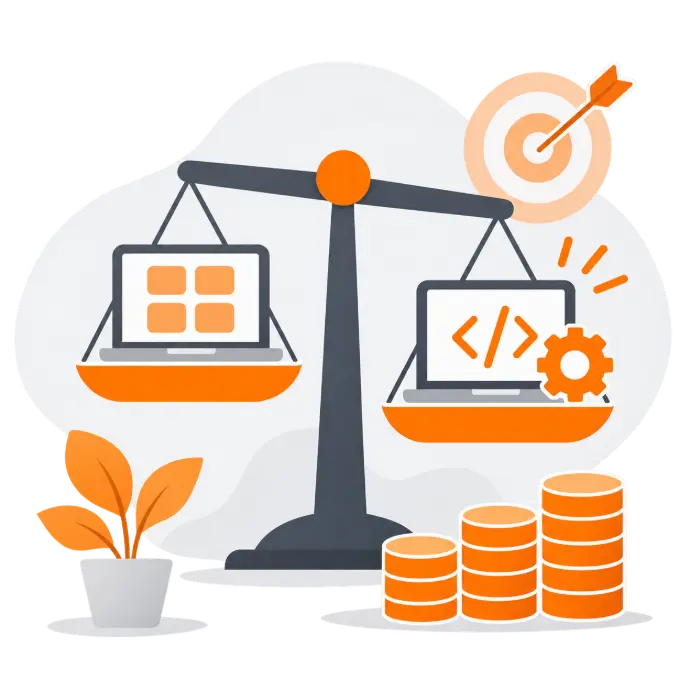
It can be hard to say exactly when custom-developed software pays off. It depends partly on what your current solution(s) cost you today, and partly on what it costs not to have custom software of your own, that is, the cost of time spent on repetitive tasks, of errors that have to be found and corrected, and of employees having to use several systems to get the job done.
Custom software may be worth considering if:
- your workflows differ from the standard, so a standard system requires many adaptations
- important tasks are handled in Excel or with manual checks
- the same data has to be entered in several places
- calculations, quotes or documentation must be precise, and errors are costly
- many users, both employees and customers, work in the solution regularly
The more of these points that apply to you, the stronger the case for custom development. If the main issue is that the same data has to be entered in several places, integrations between your existing systems are typically a better solution.
Solutions we have built for our customers
Every business has its own workflows, which is why two custom-developed solutions rarely look alike. Some are used internally by employees. Others are aimed at customers, retailers or partners, who need to be able to use the system themselves.
The cases below are a selection of the solutions we have developed. They are all different, but what they have in common is that they solve concrete tasks in the users' everyday work.
APROMAS
We have developed a planning and process management tool that supports order handling at claim centers and auto paint shops, from first customer contact to invoicing. The solution was developed in close collaboration with the industry and the system's users.
Sitepas
Together with Nordic Waterproofing, we have developed an app and web interface that streamline work processes and documentation. The solution started out as Tagpas, has since been developed further for several industries, and is now called Sitepas.
Aarhus Kommune: Genlyd Aarhus
We have helped Aarhus Municipality give Genlyd Aarhus, the municipality's digital community platform, a modern technical foundation, making it easier to run, maintain and develop further.
Read the case about Aarhus Kommune ->
JUAL A/S
An extensive Excel sheet for technical calculations has become a configurator that performs the calculations and produces a PDF report with a parts list. It is used by JUAL itself and as a self-service tool for its customers.
Skovagerskolen
The school got a more flexible and manageable solution for planning, where student data, transport and communication are gathered in one place.
Read the case about Skovagerskolen ->
Purus & Rita Din Diskbänk
Purus had a design tool developed that is used daily by retailers, professionals and private customers to design bespoke worktops.
Læs casen om Purus & Rita Din Diskbänk ->

Why choose itpilot as your development partner?
When you have software developed, you choose not only a solution but also a partner. It is therefore important that the supplier understands your business and builds solutions that can evolve with you.
At itpilot, we have been developing software since 2008. From our offices in Viborg and Aarhus, we have helped both private businesses and public organizations. We value close, personal collaboration with good communication.
We handle development, integration with your other systems, hosting and support, so you don't have to coordinate several suppliers yourself. We develop future-proof solutions that are built to be used in everyday work and to be developed further as your needs change.
Not sure whether itpilot is the right partner for you? Contact us for a no-obligation conversation about your needs.
Shall we talk about your next system?
Whether the answer is custom software, a standard system or an integration between the systems you already have, we are happy to help you find the solution that fits.

Frequently asked questions
Her er nogle ofte stillede spørgsmål om vores virksomhed.
Typically when time, errors and detours cost more today than the solution will. This is the case, for example, if important tasks are handled in Excel or with manual checks, or if a standard system requires so many adaptations that it is no longer standard. The more of these that apply to you, the stronger the case for custom development.
It depends on how extensive the solution is, how many users will use it, which systems it needs to connect to, and how it will be operated. Once we know your needs and scope, we can give you a no-obligation quote. If the budget is limited, it can make sense to start with a clearly defined first version that can be developed further.
Often, yes. If the challenge is mainly that the systems don't talk to each other and data is moved manually, integrations between your systems can be a better solution than replacing a system. You keep the systems you know and avoid double entry. If the challenge lies in the workflows themselves rather than in the data flow, custom software is the more obvious option..
Yes. It can be a sensible path if your needs are not entirely clear yet. It helps to plan for data and integrations from the start, so that a later switch does not require you to start over.
Yes. Custom software can, for example, be a self-service solution where customers and partners generate quotes, collect documentation or submit reports themselves. They can also be given the option to create users and assign roles within their own organization, so they decide who may do what. This gives them a faster process and relieves your team.
Yes. A custom solution does not have to be finished when it goes live. We can build it so that new features, configurators and integrations can be added as the need arises. This has happened with Sitepas, for example, which has been developed further for several industries.
Yes. When data is gathered in one place, it becomes easier to follow up and make decisions. Data from the solution can be used for reporting and analysis via a data warehouse and BI.
t is perfectly normal not to know from the start, and you don't need a finished requirements specification. It helps to be able to describe which task it concerns, who uses it today, which systems or Excel sheets are involved, and where it gets difficult. From there, we clarify your needs and workflows together and assess which functions matter most. Contact us, and we will help you get started.
We work professionally with projects and follow a structured project process, so you have an overview from the first clarifications until the solution is in operation.
es. We can take care of both development, integrations between systems, hosting and support, so you have one partner and don't have to coordinate several suppliers yourself.
We hold both ISAE 3402 and ISAE 3000 declarations. Read more under our certifications.
itpilot develops custom software for both private businesses and public organizations and has done so since 2008. We work from offices in Viborg and Aarhus. See examples under Solutions we have built for our customers , or read more about custom-built IT systems.