Get a B2B webshop that fits your business
We help B2B companies develop webshops that streamline order flows, make it easier for customers to buy, and integrate with ERP, PIM, warehouse management and other systems.
Whether you want to digitalise manual processes, optimise an existing solution or build a more scalable platform, we take your business, workflows and needs as our starting point.
Why B2B companies choose to digitalise sales
For many companies, a B2B webshop becomes the natural next step when existing sales processes start to become a limitation. When orders are handled by email, phone or manual workflows, bottlenecks quickly arise, affecting both internal efficiency and the customer experience.
At the same time, customers increasingly expect a more flexible and digital way to buy, where they can access products, prices and previous orders themselves. Without a structured solution, it becomes difficult to scale the business, reduce errors and create the necessary overview.
A B2B webshop brings sales together in one place, automates repetitive tasks and gives customers a more efficient way to find products, view prices and place orders.
When is it time for a B2B webshop?
The right time depends on your business, but the need typically arises when manual processes begin to take up too much time in day-to-day operations, and when customers expect a more efficient way to buy.
- Order volume increases and becomes difficult to handle manually
- Customers request self-service
- Errors occur in prices and orders
- Sales and customer service spend time on repetitive tasks
- You want to scale without increasing staffing at the same rate
If more orders automatically mean more manual work, it is often a sign that the sales process should be digitalised. A B2B webshop is not just a digital tool. It is a way to structure and streamline the entire sales process.

Which features should a good B2B webshop have?
B2B webshops typically place different demands on a solution than standard webshops. These demands can relate to functionality, flexibility and integration.
A well-functioning B2B webshop must support both your internal processes and your customers’ needs.
Here are examples of commonly requested features for B2B webshops:
In a B2B webshop, customers expect to see their own agreed prices, discounts and payment terms when they log in. Customer-specific prices and discounts make it possible to tailor the price display individually, so each customer sees the prices and agreements that apply specifically to them.
You can also set up flexible volume discounts, campaigns or discount structures that automatically adapt based on customer type, agreement terms or purchase volume. This is especially relevant for companies where customers buy in larger quantities or have individual commercial agreements.
With a secure customer login, you can give customers access to their own prices, products, documents, orders and agreements. At the same time, you can control which information and functions each user or user group has access to.
This is particularly relevant in B2B, where one customer often consists of an entire organisation with several employees, departments and roles. Under the same customer profile, there may be buyers, managers, controllers or technical staff, each with different needs and permissions.
With role-based access, the webshop can support the customer’s internal purchasing process. One user may be able to create orders, while another needs to approve them, view invoices, manage users or access specific products and agreements. This makes the webshop more flexible and better suited to the way professional customers work.
Customers should be able to quickly find previous orders and easily reorder products. With a clear order history and a “buy again” function, customers save time and can more easily repeat regular purchases without having to search for the products again.
This makes the webshop more efficient in everyday use and also increases the likelihood that customers return and use the solution as their preferred ordering channel.
Professional B2B buyers often want to order quickly and efficiently, especially when they already know which products they need. With features such as quick ordering by item number or upload of order lists in formats such as Excel or CSV, customers can complete large orders in just a few minutes.
This removes the need to click through the entire product range and makes the webshop far more useful for customers who work with recurring, large or structured purchases.
If you sell internationally, it is essential that the webshop supports multiple languages and currencies. With properly localised content, prices and currency settings, you can create a professional experience regardless of where your customers are located.
Language and currency management is particularly relevant for companies selling across markets, subsidiaries or dealer networks, where customers expect a buying experience that matches their local needs.
In large product ranges, it is important that customers can quickly find the products they are looking for. Effective search functions, advanced filters and clear categorisation make it easier to navigate complex product catalogues.
This is especially important in B2B webshops, where products often have many technical specifications, variants or compatibility requirements. A strong search and filter structure creates a better user experience and can also increase conversion.
Transparency around stock status gives customers confidence and makes it easier for them to plan their purchases. If a product is on backorder, the webshop can provide information about expected delivery times, alternative products or the option to pre-order.
If inventory management is handled through ERP or another internal system, an integration can ensure that customers always see current stock data directly in the webshop. This reduces uncertainty and minimises the need for manual enquiries.
A B2B webshop creates the most value when it connects with the systems you already use for order processing, inventory, finance and customer data. With integration to ERP and finance systems, data can flow automatically between the webshop and your internal processes.
This means that orders, prices, stock status, invoicing and customer data can be handled more efficiently and with fewer manual errors. For many B2B companies, the integration itself is what turns the webshop into a real optimisation of sales and operational processes.

Product configurators make complex products easy to buy
For companies with technical or composite products, it is important that customers can find the right solution without unnecessary manual dialogue. With a dedicated product configurator, customers are guided step by step through relevant choices, so only valid combinations can be selected.
When complex products are presented in a structured and user-friendly way, the risk of incorrect orders is reduced, while the buying process becomes faster and more efficient. This creates a better experience for the customer and frees up time internally in the organisation.
We can develop both simple and advanced configurators, for example with advanced price calculation, where add-ons and rules automatically affect the final price, as well as restrictions and dependencies that ensure only technically possible solutions can be selected.
Read more about development of product and sales configurators here ->
A B2B webshop can also start as a digital product catalogue
A B2B webshop does not have to start as a full e-commerce solution. For many companies, it makes sense to first establish a structured platform that functions as a digital product catalogue or showroom.
Here, customers can access updated product data, documentation, images and variants in one place, creating a better overview and making it easier to work with the products in everyday use. At the same time, a solid structure is built that can later be expanded with ordering functionality and full e-commerce.
This approach makes it possible to digitalise at a pace that suits the business and ensures that the solution can develop as your needs evolve.

Get a B2B webshop that integrates with your systems
A B2B webshop only creates real value when it connects with the systems you already use every day. That is why we see integrations as a central part of the solution – not something to be considered afterwards.
When the systems work together, you achieve:
- Less duplicate work
- Fewer errors
- Faster processes
- Better data quality
- A better customer experience
- A more scalable solution
We have many years of experience with system integrations and work with both standard-based and custom integrations. We advise you on the options and develop integrations that fit your setup – without locking you into specific platforms.
PIM and product data – manage your data in one place
For many B2B companies, product data is one of the biggest challenges when working with a webshop. When products have many variants, technical specifications, images, data sheets and translations, it quickly becomes difficult to maintain data in multiple places.
A PIM system collects and structures product data in one central place, so product information does not have to be updated manually in the webshop, catalogues, price lists and other sales channels. This provides better data quality, more consistent information and a more efficient workflow when the product range changes or needs to be presented across markets and languages.
With a PIM system, you can achieve:
- Data maintained in one place
- Consistent product information
- Efficient handling of large data volumes
- Lower risk of errors
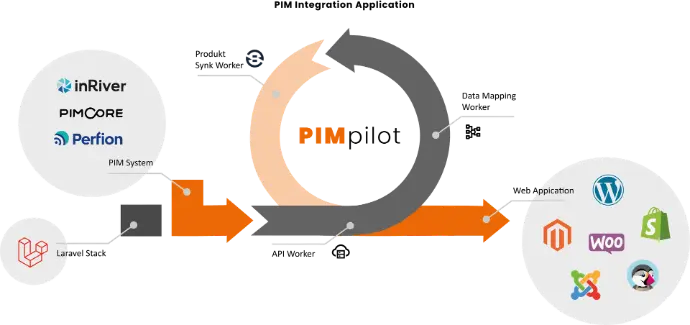
With our PIMpilot solution, we integrate PIM systems such as Pimcore, inriver and others with the webshop, so your product data is connected across systems. This means data can be updated in one place and automatically distributed to the webshop, ensuring that customers always see accurate and up-to-date product information.
Choosing the platform for your B2B webshop
Choosing the right platform is a strategic decision that affects flexibility, integrations and opportunities for further development. At itpilot, we work independently with several different webshop platforms, and we do not try to fit every project into one preferred solution.
Instead, we take your business as the starting point and assess which platform best supports your needs – both now and in the long term. Some companies need a high degree of flexibility and advanced customisation, while others focus on stable operations and simple administration.
The choice of platform also depends on whether the solution is primarily intended for ordering, a product catalogue, a configurator or an integration platform.
Our role is to advise you on an informed basis, so you make a choice that works in practice and does not limit your future options. We have extensive experience with WooCommerce, PrestaShop, Magento and Pimcore CMS, among others, but we always choose the platform based on what creates the most value for you.
Read our guide to choosing a platform for your B2B webshop ->
Can we help you move forward?
Whether you are considering a new B2B webshop, want to optimise an existing solution or are unsure about platform and integrations, we would be happy to have a non-binding conversation about your options.

How a B2B webshop project works
We work in a structured way when developing B2B webshops, so you have a clear overview throughout the entire process.
1
1. Clarification of needs and goals
We review your business, products, customers, workflows and ambitions, so we get a clear understanding of what the solution needs to support.

2
2. Design and structure
We define the structure, features, data flow and integrations, so there is a clear plan for both the user experience and the technical solution.

3
3. Development and integration
We develop the webshop and connect it with relevant systems such as ERP, PIM, CRM, warehouse management or finance.

4
4. Testing and quality assurance
We test features, data, integrations and user flows to ensure the solution is stable and ready for use.

5
5. Launch and further development
The webshop is put into operation, and we can subsequently help with hosting, support, optimisation and further development.

Operations, hosting and further development of your B2B webshop
A B2B webshop must run reliably every day and be able to develop in line with your business. That is why we offer a complete solution where operations, hosting, optimisation and further development are considered from the start.
If you already have a B2B webshop, we can also help analyse and improve the existing solution. This may involve technical limitations, performance, integrations, user experience or new features that can better support your business.
We work in a structured way with both operations and further development, and we have a strong focus on security and operational reliability. Our processes are documented and supported by ISAE 3402 and ISAE 3000, which document controls and workflows within operations, security and data processing.
Whether you want to optimise an existing webshop or secure a stable platform for the future, we help you create a solution that works today and can be developed tomorrow.
Why companies choose itpilot
A B2B webshop requires more than technical development. It must fit your products, customers, workflows and systems – and it must be able to evolve as your needs change.
At itpilot, we combine technical development with business understanding, integration expertise and a structured approach to operations and security. This means you get a partner who can help with strategy, development, implementation and further development.
We provide honest advice on both opportunities and limitations, so you get a solution that works in practice – not just on paper.
Examples of solutions and collaborations
B2B webshops can look very different depending on the industry, products and internal processes. Some solutions focus on online ordering and customer-specific prices, while others function as digital product catalogues, configurators or platforms with advanced product data.
Here you can see examples of solutions where we have helped companies make complex products, data and sales processes more digital and user-friendly.