How to create a requirements specification for your app
Do you need to have an app developed, but are you unsure of what it should actually be able to do? Then a requirements specification is the first important step. It helps you put into words what the app should be able to do, and it gives our project managers and developers a much better basis for advising you, estimating the scope and getting the project started.
At itpilot, we constantly receive inquiries about app development. Some only have an idea on the drawing board, while others have already made a detailed list of requirements. No matter how far along you are, we will help you further.
When you contact us, you can expect a professional process - from idea to fully developed app (read more about the process here). We always prepare the requirements specification together with you, and we ensure that it becomes a useful working tool throughout the entire development process.
If you want to prepare yourself before contacting us, you can use the list below as a starting point. It contains typical topics that are relevant when working with a requirements specification, both when it comes to functions, flows, user types, technical requirements and testing. It is not certain that all points are relevant to your particular app, but it is a good framework to create an overview – both for yourself and for us when we have to advise you and give a realistic price indication.
What is a requirements specification and why is it important?
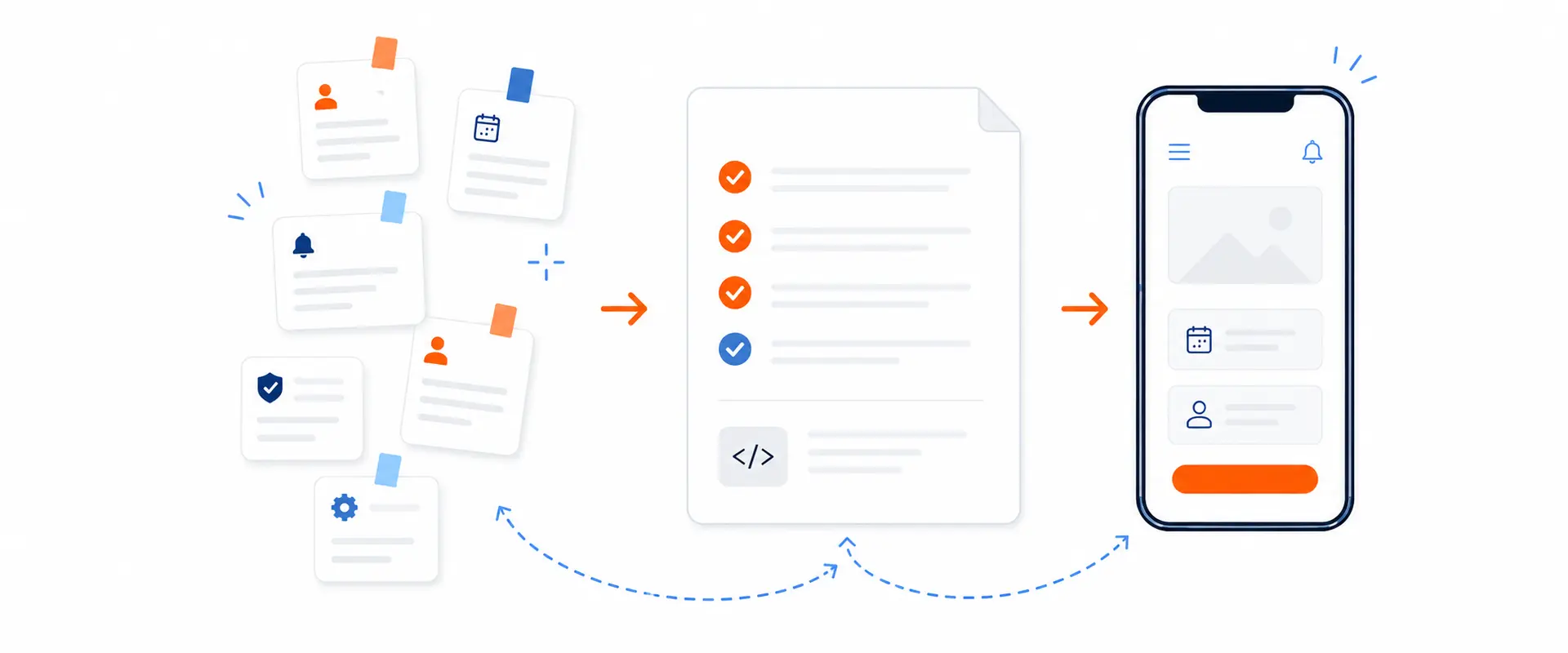
A requirements specification is a structured description of what an app should be able to do, how it should function, and what frameworks apply. Although it sounds technical, in practice it is about creating an overview and avoiding misunderstandings right from the start.
A good requirements specification ensures that all parties agree on what needs to be developed and how the app should function. It creates shared expectations and makes it easier to plan, prioritize and collaborate.
During a development project, new ideas often arise, and that is quite natural. Some ideas may be integrated along the way, others may require changes in scope and budget. Here, the requirements specification serves as an important tool: It makes it clear what was originally agreed upon, and what new wishes or additions may exist.
What should a requirements specification contain?
A requirements specification can look in many ways, depending on what type of app you need to develop, who the target audience is, and how the app will be used. There is no one right recipe. However, there are some basic elements that are almost always relevant to consider.
To make it easier to get started, we have compiled a list of typical elements and questions. The list is not a checklist that must necessarily be completed point by point, but it can give you a good starting point to get a handle on functions, flows, requirements and expectations.
The list is also helpful to us: The better we understand your needs and priorities, the better we can advise you and provide a realistic price indication for the development work.
Start the requirements specification with a short and clear description of what the app should be able to do. What is the overall purpose of the app, and who will use it? This is where you set the framework for the rest of the project – both in terms of function, target audience and business value. The clearer the purpose and context, the easier it will be to make the right technical and design choices.
- What is the purpose of the app? (e.g. “simplify booking of premises”, “keep track of employees’ working hours/tasks”, “connect car owners with workshops”, “simplify documentation work for tasks”)
- Who is the app's primary target audience?
- What problem should the app solve?
- What type of app is this? (native, web app, hybrid etc.)
- Is the app to be used internally within the company, or is it a commercial product?
- What platforms should the app work on? (iOS, Android, browser, tablet, etc.)
Here you describe the basic framework and assumptions under which the app will be developed. This can be anything from strategic considerations to language requirements, accessibility, design manuals or a specific launch date. These factors often govern the direction and scope of the project and should therefore be clearly formulated from the start.
- Should an existing business model, strategy or branding be taken into account?
- What language should the app be in? Should it support multiple languages?
- Are there accessibility requirements (WCAG, screen readers, color contrasts)?
- Does the app have to follow certain design manuals or technical standards?
- Does the app need to be launched at a specific time?
- Do you have a budget or financial framework for the project?
This section forms the core of the requirements specification. Here you describe which functions and actions the app's users must be able to perform. This applies to both basic functions (such as login and profile) and more specific flows (such as bookings or task management). This is also where you define user roles and differences in access or functionality. Be as specific as possible, as this helps create a common understanding and align expectations for the solution.
- What functions should the app contain? (e.g. login, profile, calendar, search, notifications, payment)
- Should there be different user roles (e.g. administrator, editor, user, partner)?
- What can each role see and do?
- Is onboarding of new users needed?
- Which flows are central? (e.g. “create a booking”, “submit a task”, “book an appointment”)
- Should the user be able to receive messages or reminders (push or email)?
- Should the app work offline in certain situations?
This section gathers all the technical and operational requirements that are not about functionality, but that have a major impact on the quality and stability of the app. These can include requirements for performance, uptime, security, offline functionality, and maintenance. These requirements are often crucial for a robust and long-term solution – especially if the app is to be used in critical or professional contexts.
- Does the app need to be able to handle many simultaneous users?
- Should there be high uptime (e.g. 99.9%)?
- Are there requirements for response time and performance?
- How should the app be updated and maintained?
- Should the app be able to work offline/partially offline?
- What security requirements do you have (data encryption, session timeout, access control)?
- Should the app be version controlled, and is rollback possible?
If the app is to exchange data with other systems, it is important to clarify which integrations are necessary. This can be anything from login with MitID to integrations with ERP systems, payment solutions or calendars. This should also state whether there are existing APIs and whether there is access to documentation. Clear requirements for integrations ensure that the system is coherent with the rest of your IT landscape.
- Does the app need to retrieve or send data to other systems? (ERP, CRM, payment gateway, calendar systems, etc.)
- Should the user be able to log in via, for example, Microsoft, Google or MitID?
- Are there existing APIs that need to be used, and do you have documentation?
- Should the app be able to handle webhooks or synchronization with external databases?
- Is there a need for integration with hardware (e.g. Bluetooth devices, QR scanners, camera)?
Also remember to note if some integrations will only be implemented in a later phase - this can help manage the project's scope and priorities.
Data is often the core of an app and at the same time an area with many requirements and considerations. In this section, you describe what types of data the app will handle (e.g. personal data, location data, sensitive information), how data is stored and protected, and how you comply with legislation such as GDPR. It is also important to clarify who has access to what, and whether the user should be able to manage their own data.
- What types of data are handled? (personal data, location data, sensitive information?)
- Where is data stored – locally, in the cloud or on own servers?
- Should there be consent and informed use of data (GDPR)?
- Should users be able to delete or export their own data?
- Who has access to which data?
- Should there be logging of actions in the system?
- Should data be anonymized, pseudonymized or encrypted?
The app's design and user experience are of great importance for its success. In this section, you describe your wishes and requirements for the visual expression and the way the user navigates the app. Do you have a design direction you want to follow? Do you need to create wireframes or mockups, or do you already have some ready? This is also where you can describe navigation, screen layout, and inspiration from other solutions.
- Do you have ideas for how the app should look? (colors, style, tone of voice)
- Do you need wireframes or mockups, and do you already have something on the drawing board?
- Are there similar apps that you are inspired by?
- What elements should be available on the front page/screen?
- How should the navigation work? (bottom menu, burger menu, swipe, etc.))
- Does the layout need to be adapted to different screen sizes?
- Do you need help with UX/UI design from us?
A good requirements specification should not only list features, but also describe how the app is used in practice. Use cases and flows show concrete situations where the app must solve a task from the user's perspective.
It helps both you and the development team better understand the needs, spot gaps, and ensure consistency in features. Also use this section to illustrate complex flows and identify critical steps where the user may experience confusion or errors.
- Usage scenarios for each user group (e.g. student, teacher, administrator)
- Step-by-step flows for important actions (e.g. create booking, cancel participation, submit documentation)
- Expected user behavior and context (where, when and why the app is used)
- Description of edge cases and exceptions
- Relationship to functional requirements and how flows support these
Early clarification of testing strategy and quality requirements makes it easier to develop a stable and secure solution. This section is about how we will jointly ensure that the app works correctly and that the requirements are actually met.
- Requirements for automated and manual tests
- Roles and responsibilities for testing (e.g. supplier vs. customer)
- User tests and test scenarios based on use cases
- Expectations for stability and margin of error when submitting
- Requirements for test data and test environments
- Acceptance criteria and approval process
Your requirements specification doesn't have to be perfect.
… but it pays to think things through.
We don't expect you to have all the details in place when you contact us, and you certainly don't need to have a complete requirements specification ready. But it's an advantage if you've thought about what the app should be able to do and who will use it in advance.
The more you have thought through, the easier it is for us to understand your needs and provide qualified input – both when it comes to functionality, architecture, technical choices and further development options.
As mentioned earlier, we always prepare the final requirements specification in close collaboration with you. This ensures that we have a common starting point before we move on to design, development and testing.
Should we help you develop an app?
At itpilot we have many years of experience in developing apps, both as standalone solutions and as part of larger systems. We help you all the way from idea and requirements specification to design, development and implementation.
Whether you have a concrete idea or are just starting to think about it, we would be happy to have a non-binding chat about your options. Contact us today for a non-binding chat, and together we will find out how your app project can best be achieved.
Call us on tel +45 87 25 07 87 or fill out the contact form.
